image

Archive for the ‘Gastronomy’ Category

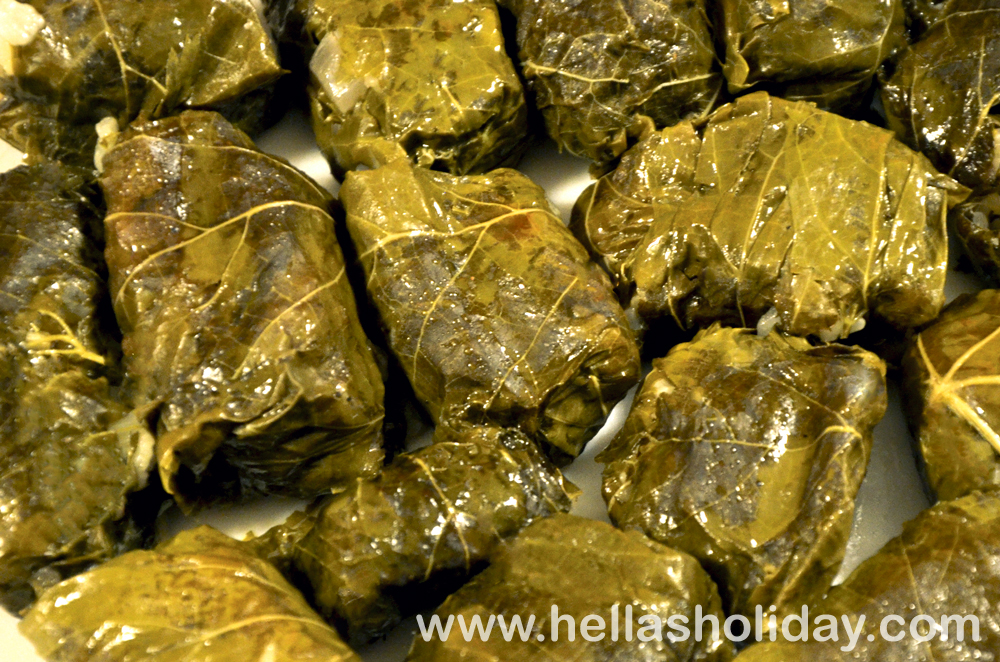
Served Dolmades

Spring is finally kicking in again and nature around us is starting to gain back its vivid colours! For those of you living in the Northern hemisphere, this is the perfect time to make Dolmades or —in their smaller version— Dolmadakia.

If you live near a grape-producing region or if you happen to have a few vine trees in your garden, then get outside and collect a few fresh leaves for this great recipe. The leaves need to be big enough to be stuffed, but at the same time young, so that they are tender too. Also, make sure they are not sprayed with any fungicides or other chemicals. Note that in cooler climates you may need to be a little more patient until the vine tree leaves are ready to be picked.

If you would like to collect the leaves right when they are at the optimal growth stage, but wish to make Dolmades later, or if you wish to collect enough leaves for the rest of the year, then you may as well freeze them. Read through to see how you can do this.

For those of you that do not have access to fresh leaves, you can try using the ones in brine, usually sold in jars at supermarkets. Of course these are not going to be as tasty and tender as fresh ones are, but they will still do the job, and if your stuffing and technique are also good, then the result will still be delicious!


Ingredients for Dolmades

This recipe is for 4-6 persons if served as a main or for 8-12 persons if served as appetiser, but it can be easily halved or doubled.

  • 300 g of vine tree leaves (this roughly corresponds to 50–60 leaves), fresh or in brine
  • 2 cups (400 g) of uncooked non-aromatic long-grain fluffy rice, such as Carolina
  • 4 large white or red onions
  • 3–5 spring onions
  • 1/2 cup of chopped fresh dill (or to taste)
  • 1/2 cup of chopped fresh parsley (preferably flat parsley)
  • 10–20 spearmint leaves
  • 1 cup of extra-virgin olive oil
  • the juice of 1 medium lemon
  • 1 level tbsp of salt (preferably sea salt)
  • freshly-ground black pepper to taste


Method for Dolmades

Leaf preparation

For those of you using vine leaves in brine, rinse well your leaves and let the water drain. You are ready to go on with the preparation of the stuffing.

For the ones that have collected fresh leaves, here is the procedure that needs to be followed. Wash your vine tree leaves thoroughly. Place a large saucepan over high heat, fill it to up to 2/3 of its volume with water, cover and let boil. Once it comes to the boil, briefly blanch the leaves by immersing them in the water for approximately 2–3 minutes. The blanching time will depend on the age of your leaves; younger leaves require shorter blanching compared to older and harder leaves. Remove leaves from the boiling water using a slotted ladle and place them in a colander to drain. Let the leaves cool down to room temperature. You are ready to go!


At this point you may go on with the stuffing procedure or you may wrap the vine tree leaves in alluminium foil, put in a food bad and store in the freezer for future use. To make Dolmades, take the leaves out of the freezer and let them slowly reach room temperature. Carefully separate them and stuff them. This way, you can collect and store enough leaves for one year’s Dolmades.


Stuffing preparation

Rinse well all herbs. Remove the root and 2–3 cm from the top of the spring onions. Remove 2–3 cm from the stems of the fresh dill and parsley. Chop spring onions, dill, parsley and spearmint, as shown in the following photo.Spring onion and fresh dill
Peel, chop and add the white or red onions (whichever you are using).

Spring onion, fresh dill, red onion

Add the rice and half of the olive oil and mix. Season with the salt, freshly-ground pepper and half of the lemon juice. The stuffing is now ready!

Spring onion, fresh dill, red onion and rice

Lay one vine leaf flat on your palm with the nerves facing up.

Vine leaf laid with the nerves facing upwards

Add a little stuffing (approximately as much as one teaspoon).

Vine leaf with stuffing

Fold one lobe of the vine leaf over the stuffing.

Vine leaf rolling - Step 1

Fold the second lobe towards the centre of the leaf.

Vine leaf rolling - Step 2

Fold the two sides towards the centre and roll. Repeat until you roll all your leaves. 
Vine leaf rolling - Step 3

Place the Dolmades into a large and deep saucepan, as shown in the next photo. You will probably have to stack them in 2-3 layers, depending on the diameter of your saucepan, but do not make more than three layers, as the Dolmades of the bottom layers will get squashed. Add the remaining olive oil and lemon juice.

Dolmadakia in the saucepan

Cover with a heavy plate that can tolerate high heat (e.g. porcelain), to prevent the Dolmades from unrolling. If you omit this step, the rice will expand and unroll the Dolmades, and you will end up with a nice vine tree leaf risotto instead! Still tasty, but not quite what you were looking for really!
Dolmadakia in the saucepan covered with a heavy plate

Add cool water to cover the layers of Dolmades and the plate. Cook over medium heat for 40–45 minutes. Check at times and add a little more water, if necessary. For this you would have to use hot water to avoid a big drop in the temperature, which could result in the rice becoming too soft.

Serve your delicious Dolmades warm or cold. You may season with extra lemon juice, if you wish. Enjoy!
Served Dolmades

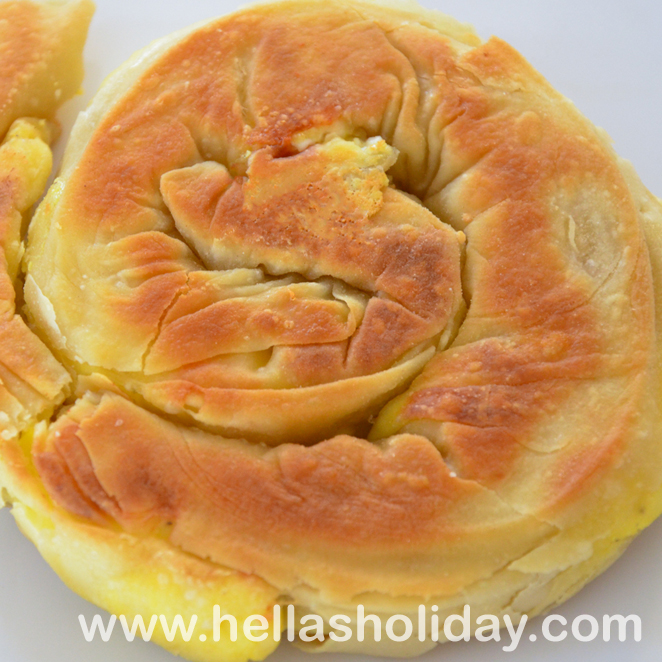
Traditional Greek cheese pie served with honeyThis delicious pie can be served as an appetiser, main dish or even breakfast and it matches really well with a drop of Greek honey (trust me on this!). The recipe comes from my best friend, whom I have known since we were six years old. She was kind enough to share with us not only her recipe but also all her little secrets for making the best homemade filo pastry. [...]

Read Full Article »

The quintessence of the Mediterranean diet on a plate

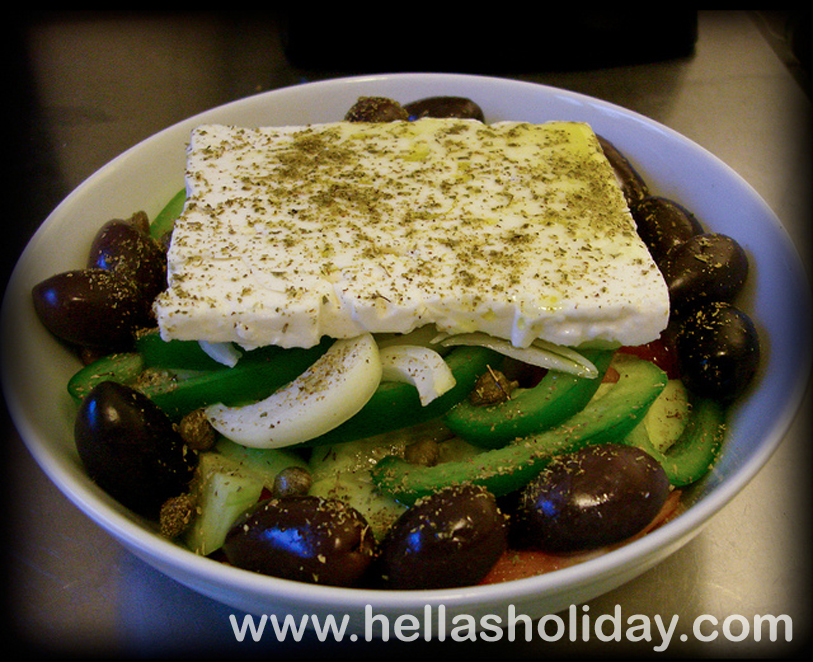
The real Greek Salad

Hooray! Summer solstice; officially the first day of summer!

No no! Wait a minute… That’s not entirely correct!

Well, actually, if we wanted to be slightly more precise, the summer solstice for the Northern hemisphere occurs exactly when the axial tilt of Earth’s semi-axis in the Northern hemisphere is most inclined towards the Sun. As a consequence, the summer solstice is more of a single moment in time [...]

Read Full Article »

Oven-baked fish with vegetables and potatoesMost of you have heard about the Mediterranean diet and its beneficial effect on our health. What you probably did not know is that the Mediterranean diet, and especially its variations adopted by people living in Greece, Italy, Spain and Morocco, is actually on UNESCO’s Representative List of the Intangible Cultural Heritage of Humanity. To be more precise, the four countries proposed a declaration to UNESCO about the Mediterranean diet, with the aim to demonstrate its diversity and raise awareness about its importance. Indeed, on the 24th of November 2010, UNESCO decided [...]

Read Full Article »

Greek honey originating from fir trees and pine treesHoney serves food, health and energy“, that is what the ancient Greek physician, Hippocrates, used to say back in the ancient times. It has also been found in old Greek poems that the Greeks valued their honey as giving the power of wisdom and eloquence. It is no wonder why the famous classic Greek philosopher Plato loved honey himself. This past greatly contributed to the reputation of Greek honey and [...]

Read Full Article »